
"I am the God of your father", he continued, "The God of Abraham, the God of Isaac, the God of Jacob."
This is how it is translated in NAB. NRSV and JPS 1917 also render it as "father", singular. New Jer renders it as ancestors.
The thing is, we really do not know who the father or ancestors of Moses really were. His father may have been a Hebrew of the Levite tribe. But I have often considered that his father may have been a high born Egyptian.
It is also quite likely that Moses was someone who recognized someone else as his father, or as his father in some sense.
What Moses did was syncretist, a fusing of traditions. That was his genius. He ended up attacking the Egyptian royal house with their own ideas.
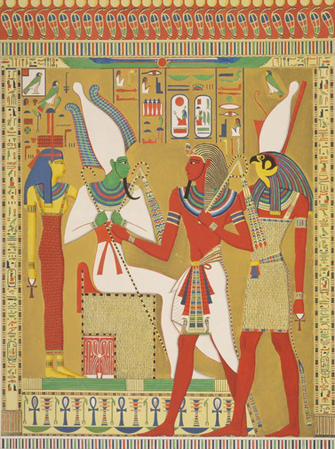
High monotheism first developed in the Mystery Schools of Ancient Egypt. These were run by the Pharoes of the New Kingdom. They were open only to a select few, and their teachings were secret. It amounted to an esoteric doctrine which operated behind their public religion.
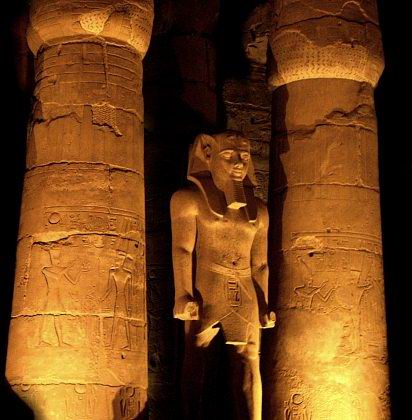
The public relgion served the state and satisfied the people. But in the Mystery Schools the idea of a more powerful diety behind the many developed. It may have been Tutmoses III who started this system.
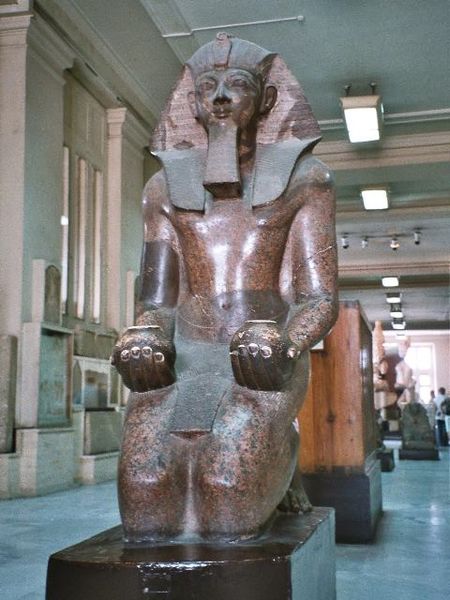
Actually the Egyptian concept of Neter does not really amount to a God, its more like a force or principle. So, polytheism and monotheism need not be incompatible. People relate to it all in different ways and at different times.
Monotheism is an insight gained through mystical experience and rationality. But it is not always what we best relate to. But to try an impose it, Aboslutist Monotheism becomes your proto Fascism.
The first who tried to impose Absolutist Monotheism, by culture war, by eradicating images, was Amenhotep IV. He built a new capital, and changed his name to Akhenaten.
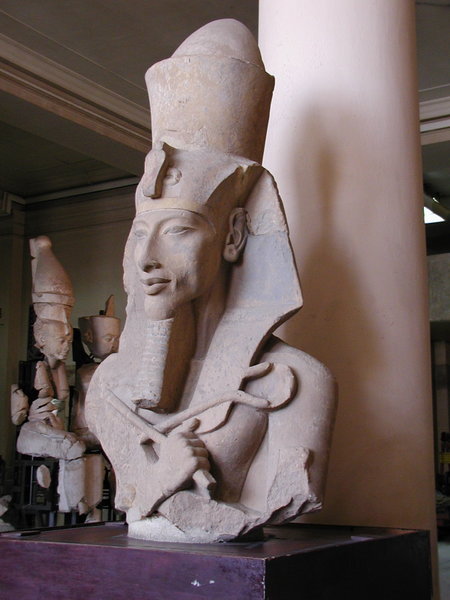
Usually history depicts Akhenaten favorably. This may be warranted. But his new religion did not last long. We don't ever hear that he was willing to perpetuate it by straping sword on thigh.
Undoubtedly the Mystery Schools continued, and it was not too many years more until Moses came along. He may have selected his own name too.
What Moses did was fully public, but it was also the most brutal attempt to impose Absolutist Monotheism in all history.
Problem is, it still results in superstitions, they are just of a different kind. You can't force people to believe a certain way, it is pointless. Idolotry means a crystalised or literalist fixation. What Moses set up works exactly this way.
Religion always involves the abuse of power too. Moses changed none of this.
The Call of Moses, and the monotheism of the Mystery Schools are the same. Its not that it needs to be kept secret, its simply that you can't set up a culture war, you can't use it to oppose common culture.
We claim monotheism, but our greatest musems are filled with pagan artifacts, and our entertainment culture is saturated with pagan mythology. To eliminate this you would first have to eliminate all religion, because it is filled with pagan thems as well.
Really, there is nothing inherently wrong with paganism or polytheism. Its just that you always end up wrestling with questions about how many prime movers there are in the universe. Christianist nuts go on and on about Satan. Most people believe in all sorts of things like Luck, Fate, Money, and the Economy.
What is more worthwhile than telling people what they should believe is to try and surface what they actually do believe and then try to decrystalize it. Pick it apart, see how it actually works.
It is when beliefs are crystalized or literalized that you have the problem of idolotry.
Ritual should take us into the unknown, inviting us to go futher than we have gone before. It should not be some neurotic exercise in concensus reality.
